Monday, December 24, 2012

Merry Christmas and Happy Holidays!


"and the stockings were hung by the chimney with care"


We have a house full this year. Children and Grandchildren abound. There's a lot of work required to schedule and prepare meals........we wouldn't have it any other way. I hope everyone enjoys spending time with their family this holiday season.

Merry Christmas and Happy Holidays,

Ron

Thursday, December 6, 2012

Just Add Wood


When a woodworker without prior metal working background or experience looks at a plane body they typically assume that this is the most challenging part of making a plane and honestly making close tolerance parts that go together to make a very close tolerance assembly is a rather challenging undertaking. This requires the acquisition of a whole new skill set so it does probably seem quite a daunting task.

So now we are to the point of fitting the wooden bits and because we're all familiar with working wood this should be easy right? Think again. The woodworking required to create a plane made to a very high standard can easily be as challenging as making the metal parts of the tool.

The individuals that blazed the trail of independent plane making, especially infill planes, set a very high fit standard. Anyone pursuing this work subsequently must be able to create work at this standard in order for their work to be accepted or considered top caliber. If you're looking to create comparable work then just okay is not good enough.

The point I wish to make is this. There is an awful lot of work left to be done when the plane body is finished and the woodworking starts, and as James Krenov was known to say, "there's still time to mess it up". That is true right up to the end. Funny thing is, everything I've done for a living in the past 20 years has been one of those "there's still time to mess it up" type pursuits. I guess I enjoy the challenge.

As you can see in these picture I've got this to do four times in the near future. I'll let you know how it turns out.


If you don't have anything really pressing for the next 3 minutes or so you might enjoy the video below.  I certainly did.


Ron


An old saying from India,


Everything will be okay in the end, if it’s not okay then it’s not the end”

Friday, November 16, 2012

Olive Wood Revisited


Have I mentioned that I like working with Olive Wood? If you read this blog regularly I guess you know that I have mentioned that a few times. Well, maybe more than a few times. Recently I've had the pleasure of completing two planes that feature Olive Wood.

One of these planes was a version of the new Winter Panel plane. This plane featured a stark contrast of the blonde olive wood against a plane body of steel with an aged patina and brass that also had a patina finish applied. During the process of making this plane I didn't really know how this would all work together but once it was completed I have to say I was absolutely smitten.


I think the color of the brass relates to the Olive enough to draw all the elements together. But Olive wood really has to be touched to be truly appreciated. This wood is naturally a bit oily and I think that's the reason it works well with a shellac finish. It almost provides it's own polishing lubrication and the feel once it is refined is something that has to be experienced to be fully appreciated.


The other wonderful characteristic of this material is the way it changes color with age. The color transition doesn't occur as drastically as you would see in rosewood which can change color in a matter of days once exposed to air and light, however the color change does occur at a more rapid rate as compared to a wood like cherry. The picture above shows just how much the color change can occur in approximately a year.

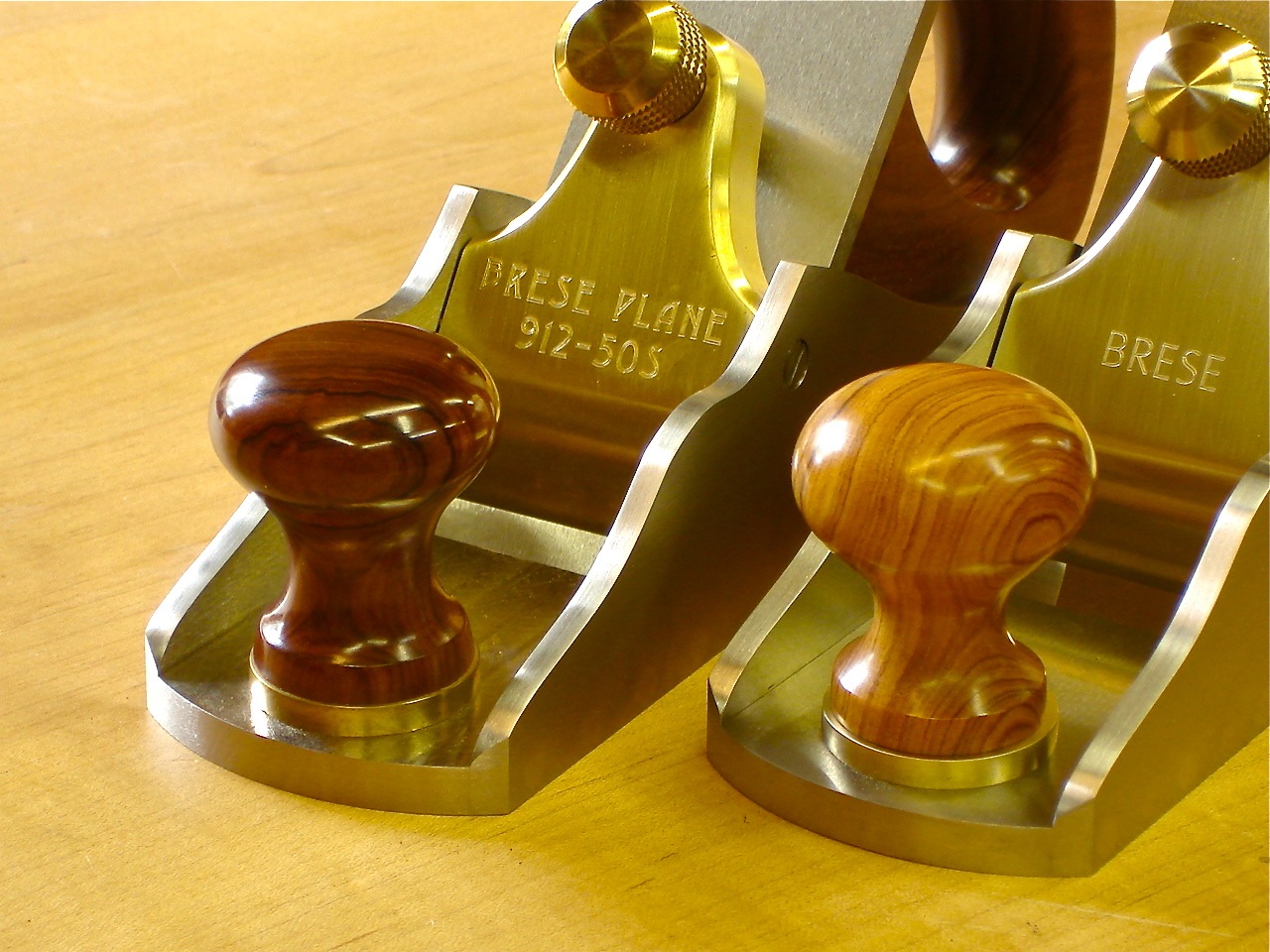
The other plane that I've recently completed is a stainless 912-50S Smoothing plane.(See Below) This tote and knob came from what could possibly be the best piece of Olive I've had the pleasure to work. Curl figure along with contrasting dark striping. Another notable thing about Olive is the curl figure gets more intense as the color darkens. The first piece of olive that I used to make plane parts did not really show any evidence of curl but once it aged curl began to show up all thru the tote and knob.

There is a lot of curl already showing in the wooden bits of this latest plane. I can't even imagine how it will look once it's aged and looking it's best.


Of course there wouldn't be much point in making a plane of this nature that didn't have performance value to match it's looks, so I've attached a video of the Winter Panel plane in action. This video is available in HD so the best viewing is obtained by selecting this quality option.


Ron


An old saying from India,


Everything will be okay in the end, if it’s not okay then it’s not the end”

Tuesday, October 30, 2012

Winter Panel Plane, a Bit Early


This plane actually started as an order for a Stainless 132-50P Panel Plane but when the customer saw pictures of the Winter Smoother from this past year he immediately called to ask if a Winter Panel Plane was in the works. Fortunately I was already thinking about a larger format plane for the Winter line of metal bodied planes and even though I pretty much had this plane sorted out in my mind I still had to put my ideas on paper.

As is usually the case,  putting my original ideas into a sketch just created a starting point. I left the sketch on my drawing board and every time I went into my office I would take some time to look at the sketch. Little by little I made further changes and refinements until finally I redrew the plane in the final version. When my customer saw the drawing he decided to change his order to this plane.


This plane is now on the way to it's new home in St. Louis. I had become attached and hated to see it go. Oh well, I get to have them all for just a little while. Besides, I have another one with Olive Wood bits very nearly finished and it has a twist.


This plane has a 2.25" wide iron pitched at 50 degrees and the sole is 11.125 long. The wooden bits are Macassar Ebony.


Ron


"I find that the harder I work, the more luck I seem to have."
- Thomas Jefferson (1743-1826)

Monday, October 15, 2012

This Plane Has a Secret


Recently a customer sent me an older infill plane for repair. This led to a discovery. The infill in this plane had become smaller and the iron was no long bedding properly. When the rear infill became smaller it also reduced in height. This in turn effectively lowered the angle of the bed which rotated the cutting edge of the iron up which meant the plane no longer had a mouth.

In order to repair this plane I had to once again make the bed 50 degrees. This wasn't a matter of removing a high spot in order to regain the proper bedding. In this case I actually needed to add some material to the bed. There is not an elegant way to add a .010 thick piece of wood to the plane bed so I decided to use the same technique I use on my metal bodied planes. At the point in which the lever cap screw applies pressure I drilled a recess to house a brass seat. I could then tune the height of the seat in order to re-establish an accurate bed angle. This solution worked great for putting the iron back at the proper pitch, however this solution effectively moved the iron off of the wooden bed of the plane except for the point at which the seat was let into the rear infill. The question of course is whether this would change the feedback the planes gives the user in use.

Miraculously I could tell no difference. The dampening was still taking place and of course this begs the question of whether it's the iron on the wood or the fact that the plane is completely infilled with wood that gives it that dampened feel in use. Of course the upper section of the iron was still separated from the metal structure of the plane by the wooden infill.

I had been contemplating a plane that was infilled yet bedded the iron on a metal bedding plate of the type that I use in my metal bodied planes. I had the perfect candidate for this experiment. The next tool in my schedule was a shooting board plane that I was to make for my good friend and customer Steve Walls. He gave me free run with the design of the plane as long as the outward appearance of the plane remained mostly unchanged.


The finished product was a plane that outwardly looked almost identical to prior versions of my Shooting Board Plane. However the secret was under the iron.  A metal bedding plate that was integral to the plane sides and a brass bedding seat.


Not having a wooden bedded version to test side by side makes my impressions of this plane somewhat speculative. However from the best of my memory this plane feels just like the prior versions in which the iron was bedded directly on the infill. I think this idea needs further exploration.


Besides the bedding plate this plane has been updated a bit. It features a new style lever cap, it now uses a 2.125" wide iron in lieu of the 2" iron in prior planes, the sole thickness has been upgraded to .437 thick, the sides have been changed from .250 to .187 thick and the body is now made from high carbon steel. This was also the first of these plane in which I used Macassar Ebony infill. With these changes and the Macassar Ebony infill the plane weighs right at 8 1/2 lbs. This kind of mass in a shooting plane is really nice.

Below is a short video showing this tool in action. It also provides a good look at an early version of the Vogt ToolWorks shooting board.


Ron


Monday, October 1, 2012

HandWorks

I'm not one to wish my life away. When you begin to get older you actually wish time would slow down. I am looking forward to cooler fall temperatures but I'm especially looking forward to next spring. However I'm not in a hurry because I need time to prepare.

As much as I enjoy fresh spring flowers and the emerging green foliage that signals the end of winter I'm especially looking forward to Memorial Day Weekend 2013.

On this weekend the Hand Tool Woodworking Community will be coming together at the Festhalle Barn in historic Amana, Iowa. I've been to this timber framed barn and as I was walking thru this building I could see this event taking place in my mind......and it was perfect! When you look up at the structure of this building it makes you think about time honored craftsmanship. What better place to hold an event that celebrates working wood with hand tools.

You can pick on the banner below and it will take you to the event web page so you can get all the details. But this much I can tell you will be happening. Saws will be sawing, planes will be producing all manner of shavings and a lot of old friends will be coming together in the spirit of working wood. I for one will be looking forward to making some new friends as well.

Hope To See You There!

Ron


"A lie gets halfway around the world before the truth has a chance to get its pants on."
- Sir Winston Churchill (1874-1965)


Tuesday, September 25, 2012

Nothing Looks Quite Like Koa and a Song


One of the most popular tools in my Stainless line of planes is the 812-50S smoothing plane. It's a great size and it covers a large scope of task for a bench plane. When luthier Richard Wile contacted me about ordering one of these planes he requested that I take my time and find an exceptional piece of material for the wooden tote and knob for this plane.

Most independent plane makers keep an inventory of quite special and even rare woods but Richard indicated he was looking for something a bit different. I had in my possession some wonderful pieces of Olive but I was pretty sure those would not be dry in time to use for Richard's plane.  Along about that time my friends Steve Walls and Charlie Levan came by the shop for a visit and when Charlie walked in the shop he handed me a piece of 8/4 koa and said "see what you can do with this". You'll see what Charlie can do with Koa at the bottom of the page.

Koa is a wood that I had investigated but I always hesitated because it is not nearly as dense as most woods used by plane makers. Well here I had a piece in my hand and I was at the point of making the wooden bits for the prototype Winter Smoother (see below) and I asked myself " why not?" I was intrigued with the Koa. The variegations in this wood are compelling.


As I was making the tote and knob for the Winter Smoother I was a bit concerned about the durability of the koa. Not so much the knob, but the tote gave me some concerns. The entire time I was shaping the rear tote I was still questioning whether or not I would actually use this tote. Once the tote was refined and it came time to apply the finish all my doubts were vanquished. Nothing looks quite like Koa!

At this point I set about looking for some Curly Koa for Richard's plane and I soon found an exceptional piece.


When purchasing  kiln dried Koa you have to consider the average moisture content of wood in Hawaii. They typically don't dry wood to a moisture content of less than 10%. In most areas it will reach an equilibrium moisture content of about 12% percent after it's been out of the kiln for a period of time. Once I had a couple of blanks in my shop they still needed time to acclimate and reach a drier condition.

When Richard's plane was complete I was smitten.  I had a hard time bagging this plane and packing it for shipment. I wanted to take just one more gossamer shaving. Oh well, I get to have them all if for just a little while.


When I informed Richard that I was editing some video of this plane in action he sent me a music file he thought I might like to use with the video. The music accompanying the video is by Richard's son also named Richard Wile and even though I don't know for sure there's a good chance the instrument he's playing was created by his father's talented hands. The young Richard Wile does a great job of manipulating a wonderful sound from this instrument with his talented hands.


And if that's not enough figured Koa for you then take a look at this picture of a Koa rocker made by my friend Charlie Levan.


Ron

If you can’t explain it to a six year old, you don’t understand it yourself.
- Albert Einstein